The short answer
Iron in well water used for irrigation is mainly a staining and equipment problem, not a plant-killing one. Extension specialists describe the common issues as rust stains on concrete and buildings, clogged drip emitters and rust-colored deposits on leaves. Iron is not generally considered a health hazard, but if you also drink from the well, it should be tested for the things that are: bacteria and nitrate, at minimum.
How common is iron in Florida well water?
Very. UF/IFAS’s Florida-Friendly Landscaping program notes that most Florida well water is high in iron, which leads to rust deposits on whatever it touches, including plants. Iron is naturally present in groundwater in a dissolved form that you cannot see. When it meets air, it oxidizes into the orange-brown form that stains.
Effects on your property
This is where most of the damage, and most of the cost, shows up.
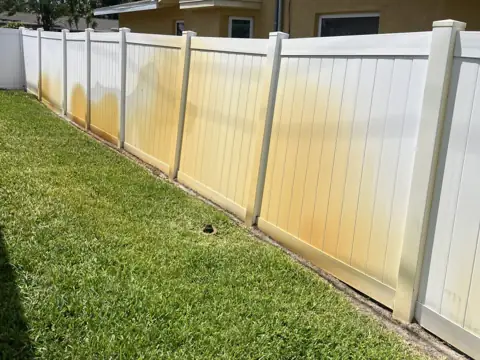
- Staining. Rutgers Cooperative Extension notes that irrigation water above roughly 0.3 ppm of iron can cause rust stains in overhead irrigation. Concrete, pavers, vinyl fencing, stucco and siding all show it.
- Property value and appearance. Orange driveways, fences and walls are among the first things buyers, residents and customers notice.
- Cleaning damage. Repeated pressure washing to fight the stains can etch concrete and wear finishes.
Iron staining is cosmetic in the sense that it does not weaken concrete. We cover that in more detail in can irrigation rust damage concrete, pavers, fences or stucco?
Effects on irrigation equipment
- Drip and micro-irrigation. The same Rutgers fact sheet notes that iron above about 0.1 ppm may contribute to clogged drip emitters. UF/IFAS also flags iron as a cause of blockages in drip systems.
- Nozzles and screens. Iron deposits and iron bacteria can build up in filters, screens and small nozzles.
- Iron bacteria. Some wells carry bacteria that feed on iron and form slimy, rust-colored deposits that clog equipment faster.
Effects on lawns and plants
This is the part people worry about most, and the answer is mostly reassuring. Penn State Extension notes that while many labs treat iron above 5 ppm as undesirable in irrigation water, that does not mean it will harm plants and soil; the practical problems center on staining, plugging of equipment and rust-colored deposits on ornamental plants.
- Leaf deposits. Overhead irrigation can leave orange or brown residue on foliage, especially on plants watered from above and on light-colored leaves. It is cosmetic for most landscape plants but can look like disease.
- Turf. Lawns generally tolerate iron in irrigation water. Iron is a plant nutrient, and many turf fertilizers contain it.
- When plants do struggle. Yellowing leaves in Florida landscapes are more often linked to high-pH water or soil interfering with nutrient uptake than to iron in the water. UF/IFAS notes that high-pH irrigation water can interfere with how plants absorb iron and other micronutrients. Your county Extension office can help diagnose plant problems.
What about drinking water?
Iron is generally treated as an aesthetic issue rather than a health hazard: it affects taste, color and staining in sinks and laundry. But iron is not the only thing that can be in a well. The Florida Department of Health strongly recommends testing private wells used for drinking at least once a year for bacteria and nitrate, and notes that Florida does not require well testing when a home is sold. If your irrigation well also supplies the house, test it for drinking-water safety, not just iron. Separate household treatment, like filtration or softening, is a different system from irrigation rust prevention. See prevention vs. filtration.
What to do about it
- Test the irrigation water so you know the iron level. A clear sample can still contain dissolved iron.
- Keep spray off hardscape and structures with head adjustments.
- Use filters and flush drip lines regularly if you have micro-irrigation.
- Remove existing stains with a treatment that dissolves iron, not just pressure. See irrigation rust removal.
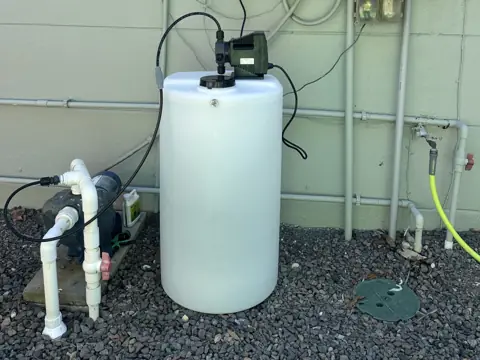
- Treat the water with an irrigation rust prevention system to stop new staining.
Sources: UF/IFAS Florida-Friendly Landscaping, “Iron in Water” and “Irrigation Water Quality”; Rutgers Cooperative Extension FS516, “Management of Iron in Irrigation Water”; Penn State Extension, “Iron in Turfgrass Irrigation Water”; Florida Department of Health, Private Well Testing.