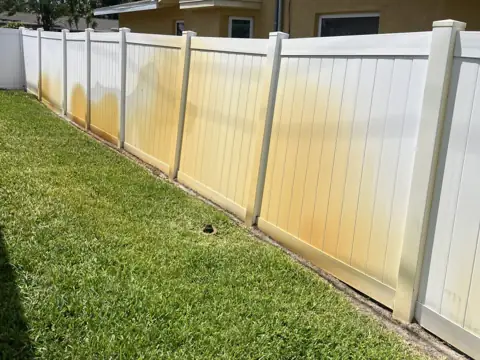
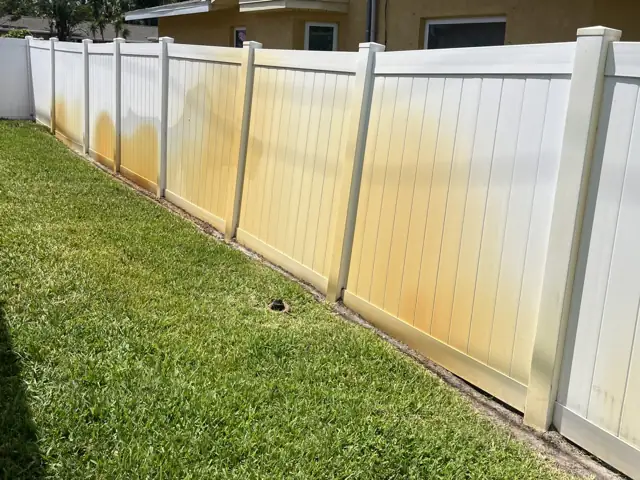
The short answer
Adjusting sprinkler heads so they water the lawn and beds instead of your driveway, fence and walls is the cheapest way to reduce irrigation rust. It cuts how much iron-rich water lands on hardscape, so stains form more slowly. It rarely stops staining completely on well water, because wind, mist, runoff and the edges of the spray pattern still reach surfaces, but it makes every other fix work better.
Find the heads that are causing it
- Run each zone one at a time in daylight.
- Stand back and watch where the water lands, especially on the driveway edge, walkway, fence and house wall.
- Mark heads that hit hardscape with a flag or a photo.
- Match the orange to the heads. The darkest staining is usually right in front of the worst offenders.
If you are not comfortable working on irrigation, an irrigation contractor can do the adjustments while you point out the stains.
Adjustments that make the biggest difference
Narrow the arc
Many spray nozzles and rotors have an adjustable arc. Turning a full-circle or wide arc down so it stops short of the driveway or fence is often the single most effective fix.
Swap the nozzle
- Part-circle nozzles (quarter, half) along edges instead of full circles.
- Strip and side-strip nozzles for narrow turf strips, like the grass between a sidewalk and the street.
- Lower-angle nozzles where wind carries mist onto surfaces.
Reduce the throw
Many nozzles and rotors let you shorten the distance the water travels with a radius adjustment. A head throwing 15 feet into a 12-foot strip is putting 3 feet of water on the concrete.
Fix tilted and sunken heads
A head that has tilted toward the driveway, or sunk into the turf so grass deflects the spray, can send water where it was never meant to go. Straightening and raising heads is simple and effective.
Move or convert heads near walls
Beds against the house, fences and pool cages are often better served by drip or micro-irrigation, which keeps spray off vertical surfaces entirely. If you convert to drip on iron-rich water, use filters and flush the lines, since iron can clog emitters.
Check run times and pressure
- Overwatering causes runoff that carries iron-rich water across driveways and sidewalks even when the spray does not reach them.
- High pressure causes misting, which drifts onto surfaces. Pressure-regulated heads or nozzles reduce it.
- Follow your watering rules. Watering days and hours are set by your water management district and local government and can change during droughts. Shorter, properly timed cycles also mean less water on hardscape.
Why adjustment alone usually is not enough
Even a well-adjusted system puts some water on edges. Wind changes direction, heads get bumped by mowers, landscapers reset arcs, and runoff finds the driveway. On well water with iron, that small amount still stains over time. Adjustment slows it down; it does not change the water.
The complete fix
- Adjust heads so most of the water stays on plants.
- Remove the staining that is already there. See irrigation rust removal.
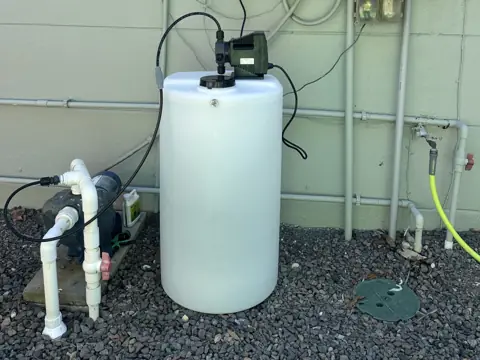
- Treat the water with an irrigation rust prevention system if you are on a well.
- Recheck heads a couple of times a year and after any landscape work.
Want to know whether your stains will keep coming back? Read can sprinkler rust stains be removed permanently?